Did Whittaker Chambers suffer from a paranoid image of the Cold War?
Read comment here, which link back to Moviefone article.
Did Whittaker Chambers suffer from a paranoid image of the Cold War?
Read comment here, which link back to Moviefone article.
From August 3, 1948, until today, America has had to wait to learn more about the head of Soviet espionage in Washington during the 1930s.
On that day, Whittaker Chambers (my grandfather) told the House Un-American Activities Committee (HUAC) under subpoena…
>Read more
…I would go further. More than muffling Whittaker Chambers’s intellectual thought, Reinsch strangles it. He narrows Chambers’s vistas to his own private passion: conversion passages in Witness (page 83). Fixation aside, nothing is new… Reinsch ditches insight for personal bias.
>Read more
(Reprint from “Letters: Muffled—or Strangled?,” published in the January 2011 issue of The New Criterion)
Reinsch’s treatment falls short… Where Chambers writes with passion and palpability, Reinsch offers fuzz. His prose muffles the screams…
> Read more here
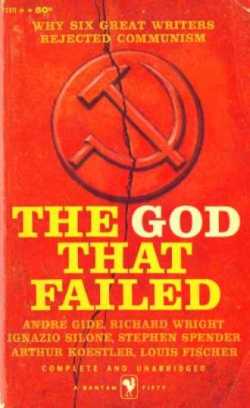
The 1949 book The God That Failed contains Louis Fischer‘s definition of “Kronstadt”: a moment in which communists or fellow-travelers decide not just to leave the Communist Party but to oppose it as anti-communists.
Editor Richard Crossman said in the book’s introduction: “The Kronstadt rebels called for Soviet power free from Bolshevik dominance” (p. x).
After describing the actual Kronstadt rebellion, Fischer spent many pages applying the concept it to some to subsequent former-communists—including himself:
What counts decisively is the “Kronstadt.” Until its advent, one may waver emotionally or doubt intellectually or even reject the cause altogether in one’s mind and yet refuse to attack it. I had no “Kronstadt” for many years” (p. 204)